My Experience with Ubuntu Desktop 26.04
I’ve been using Ubuntu 26.04 since just before its release, so I thought I’d share my experience with using it as my primary desktop OS.
This isn’t an extensive review. I’m coming to this with general prior knowledge of what Ubuntu desktop is, and what it offers. I won’t go into comparison detail, but instead what has been notable in my experience.
Some Context
I’m a long-term Linux user, who had used Ubuntu desktop a lot in the Unity days. I still use Ubuntu here and there for servers, although mainly use Debian. I currently use Linux Mint on my laptop, and in the last year I have also used Fedora, OpenSuse, ZorinOS and NixOS on my desktop.
The Positives
- The general UI and theme is well polished and looks good in my opinion. Everything feels cohesive.
- As an OS, it has been functionally sold. No hardware issues or boot failures after updates.
- I was looking for some extra stability after experiencing issues with Fedora’s more aggressive kernel updates.
- Snap packages feel improved (although see below).
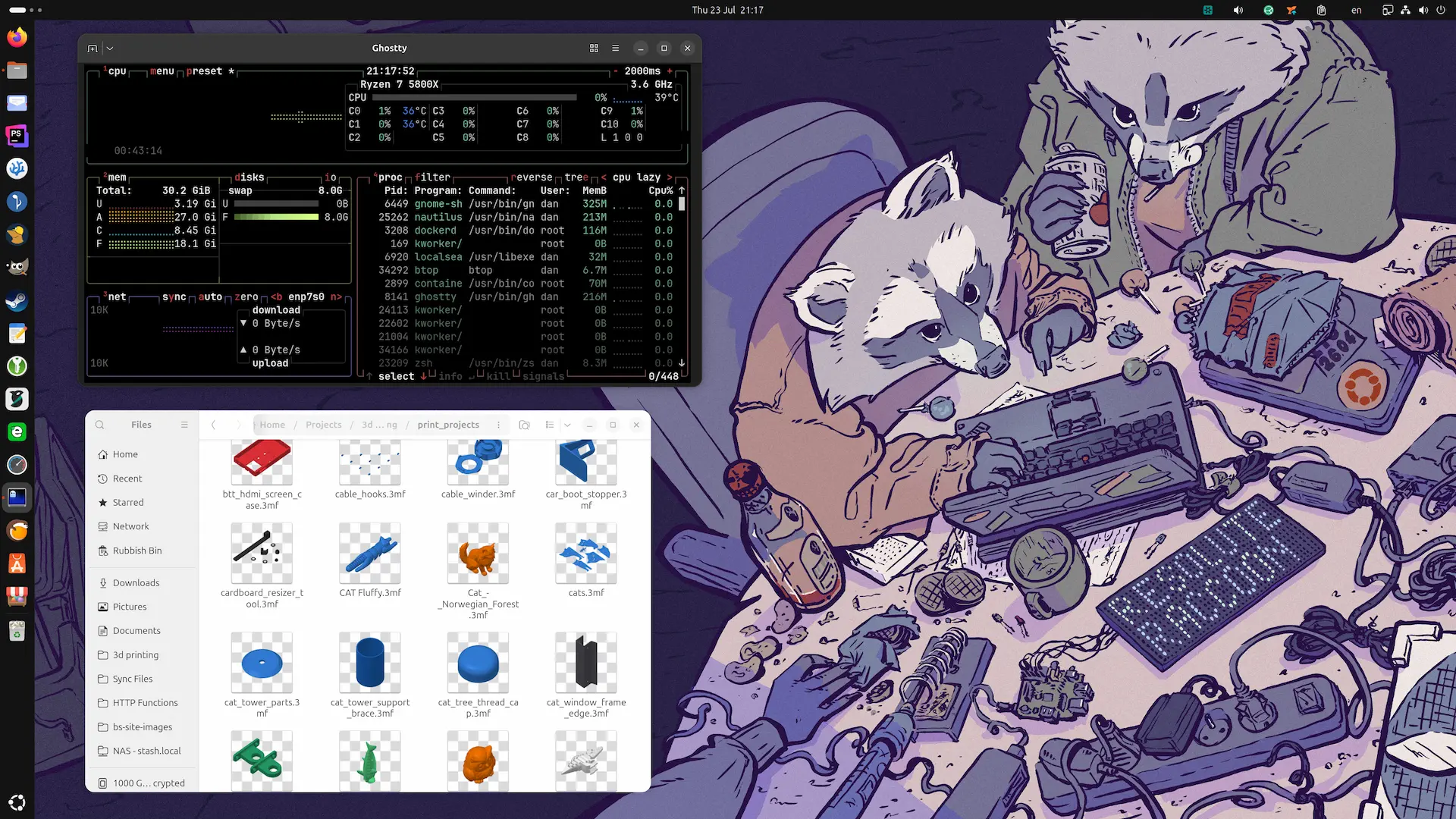
- The default wallpaper selection remains great. I especially love the one with tinkering Raccoons.
The Negatives
- The installation process seemed to break.
- This was in (late) beta to be fair.
- Not sure what went wrong, and it still resulted in a working system.
- Really not fond of how the installer would self-update, a few stages into the process, needing details to be re-filled after the update.
- Snaps are still not great.
- Compared to Flatpak, Snaps feel like they add friction while Flatpaks largely reduce/solve it.
- While app launch times with snaps have improved, they still seem a bit slow comparatively.
- The update process is still dumb. Why do I get notifications about needing to close Firefox to update it at what feels like random times? Why does it auto-start an update process when I close Firefox, preventing me from opening a new instance again for a while? I don’t like control being taken away from me like this, in a manner which gets in my way.
- It creates a dumb
~/snapfolder, adding home directory mess. - Generally faced more bugs with snap based apps, like with Steam for example.
- The app center just sucks.
- It’s hard to find apps I’m after, you have to use some dropdown to find non-snap (system) apps, random errors occur, and app updates appear to fail or stall often.
- The overall UI performance feels stuttery and slow. I think this is the same across what I suspect are Ubuntu’s Flutter based applications.
- Some of the featured apps seem odd. HEY mail was heavily featured for some time, although it had a poor rating, and viewing apps shows no kind of rating/review system so not sure where the ratings come from.
- It looks like they may now have removed the display of ratings at least.
- Now the first featured item is Nvidia OpenShell, which I feel is less likely featured there to help the average user, but to promote some sort of AI relation or partnership.
- Some applications show green or orange badges. I assume this is some kind of verification or award, but I can’t see any way to understand what these icons actually mean.
- The app install/update experience is the worst I’ve experienced. The default common Gnome/KDE experience is way better, and I’m amazed about how much better the experience on Linux Mint, where installs and updates are a joy comparatively.
- I’ve experienced some window tiling bugs.
- I’ve tried to provide feedback on this here.
- Not major, but an annoyance.
In Review
Ubuntu Desktop is a strange beast these days. I appreciate the work that Canonical have done, and continue to do, but I feel that the worst bits of the experience are all self-inflicted odd decisions. Zorin and Mint, both based on Ubuntu, provide a better overall experience. What works well for Ubuntu is the stable base, and the artistic refinement & flare.
I’ll be jumping off Ubuntu soon. Right now I’m just working on making my working environments more portable/contained, so that it’s easier to jump around operating systems. I’m thinking about maybe exploring something a bit different like Fedora Kinoite or maybe try out Alpine as a desktop OS.